
ROAS vs CPA vs CAC: Which Metric Actually Matters?
Performance marketing generates a lot of numbers, but not every metric answers the same question. ROAS vs CPA vs CAC is a common comparison for businesses trying to understand whether their marketing spend is producing profitable results.
ROAS focuses on revenue generated from advertising spend. CPA measures the cost of getting a specific conversion. CAC looks at the broader cost of acquiring a customer. Understanding the difference helps businesses choose the right marketing metrics for their goals instead of relying on one number alone.
What Is the Difference Between ROAS, CPA and CAC?
Although ROAS, CPA and CAC are all used to evaluate marketing performance, they measure different stages of the customer acquisition process.
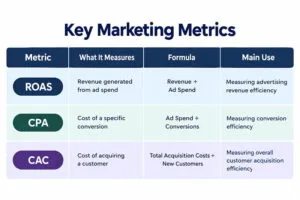
The right metric depends on what you are trying to understand about your marketing performance.
1. ROAS: How Much Revenue Does Your Ad Spend Generate?
ROAS meaning is Return on Ad Spend. It compares the revenue attributed to advertising with the amount spent on those ads.
ROAS formula:
ROAS = Revenue from Ads ÷ Advertising Cost
For example, if you spend ₹50,000 on ads and generate ₹2,00,000 in attributed revenue:
ROAS = ₹2,00,000 ÷ ₹50,000 = 4
That means the campaign generated ₹4 in attributed revenue for every ₹1 spent on advertising.
ROAS is particularly useful for ecommerce and businesses where revenue can be directly connected to advertising campaigns. However, ROAS does not automatically tell you whether the business is profitable because it does not include every operating cost.
2. CPA: How Much Does Each Conversion Cost?
CPA, or Cost Per Acquisition, measures how much you spend to generate a particular conversion.
CPA formula:
CPA = Advertising Cost ÷ Number of Conversions
Suppose you spend ₹30,000 and receive 100 conversions:
CPA = ₹30,000 ÷ 100 = ₹300
Your cost per conversion is ₹300.
The important point is that a conversion does not always mean a paying customer. Depending on how an account is configured, a conversion could be a lead form submission, phone call, registration, purchase, or another defined action.
This makes CPA especially useful for lead generation and campaign-level ad performance metrics.
3. CAC: What Does It Really Cost to Acquire a Customer?
Customer acquisition cost, or CAC, takes a broader view.
CAC calculation:
CAC = Total Sales and Marketing Costs ÷ New Customers Acquired
For example, if a company spends ₹5,00,000 across marketing and sales and acquires 100 new customers:
CAC = ₹5,00,000 ÷ 100 = ₹5,000
Unlike CPA, CAC focuses specifically on customers rather than every conversion.
CAC can include costs beyond advertising, such as marketing software, agency fees, salaries, sales expenses, and other acquisition-related costs, depending on how a business defines the metric.
ROAS vs CPA vs CAC: When Should You Use Each?
There is no single metric that should control every marketing decision.
Use ROAS When:
- You want to measure advertising revenue efficiency
- You run ecommerce campaigns
- Purchases and revenue can be tracked reliably
- You need to compare advertising investment with attributed sales
Use CPA When:
- You are generating leads or specific conversions
- You want to compare campaign efficiency
- You need to monitor the cost of individual conversion actions
- You are testing different campaigns or ad groups
Use CAC When:
- You want to understand the total cost of acquiring customers
- Your sales process involves multiple marketing channels
- Conversions do not immediately become customers
- You are evaluating broader business economics
Why Looking at Only One Metric Can Be Misleading
Imagine two campaigns:
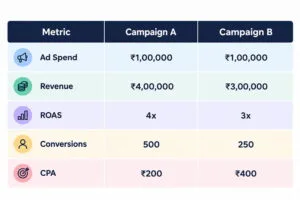
Campaign A has a higher ROAS and lower CPA in this example. But even this does not provide the complete picture.
If Campaign B generates customers with higher average order values, better retention, or stronger lifetime value, its overall economics could look different.
This is why businesses should connect marketing metrics with actual customer and business outcomes.
What Is a Good ROAS?
There is no universal good ROAS that applies to every business.
A 3x ROAS may look strong at first, but whether it is sustainable depends on product margins, fulfilment costs, discounts, overheads, repeat purchases, and other expenses.
Similarly, a low CPA is not automatically positive if the conversions are low quality and rarely become customers.
The useful benchmark is the one that makes sense for your business model and economics.
How to Build a Better Performance Marketing Dashboard
Instead of tracking ROAS, CPA, and CAC separately, look at them together.
A practical dashboard can include:
☐ Ad spend
☐ ROAS
☐ CPA
☐ CAC
☐ Conversion rate
☐ Revenue
☐ Qualified leads
☐ Customer count
☐ Average order value
☐ Customer lifetime value
This gives you a clearer picture of both campaign efficiency and customer acquisition.
Reach us for Performance Marketing Agency in Pune
Performance marketing works best when campaign data is connected to actual business objectives.
Branduo Studio combines paid advertising, campaign strategy, audience targeting, creative direction, conversion optimisation, and performance tracking to help businesses make more informed marketing decisions.
Whether the goal is generating qualified leads, increasing online sales, or improving acquisition efficiency, selecting and interpreting the right metrics is an important part of the process.
FAQs
1. What is the difference between ROAS and CPA?
ROAS measures the revenue generated relative to advertising spend, while CPA measures the advertising cost required to generate a specific conversion.
2. Is CAC the same as CPA?
No. CPA measures the cost of a defined conversion, while CAC measures the broader cost of acquiring an actual customer.
3. Which metric is better, ROAS or CAC?
They answer different questions. ROAS evaluates advertising revenue efficiency, while CAC evaluates the broader cost of acquiring customers.
4. What is the ROAS formula?
ROAS = Revenue from Ads ÷ Advertising Cost.
5. What is the CPA formula?
CPA = Advertising Cost ÷ Number of Conversions.
6. How is CAC calculated?
CAC = Total Sales and Marketing Costs ÷ New Customers Acquired.
Final Thoughts
ROAS vs CPA vs CAC is not about choosing one metric and ignoring the others. Each metric provides a different view of performance.
ROAS helps you understand advertising revenue efficiency. CPA shows the cost of generating conversions. CAC gives you a broader view of customer acquisition.
When these metrics are considered alongside conversion quality, margins, retention, and customer lifetime value, businesses can make more informed decisions about where to invest their marketing budget.