

Performance Marketing vs Digital Marketing: Key Differences
Running ads online is only one part of digital marketing. Some campaigns focus on building awareness and long-term visibility, while others are designed to generate a specific result such as a lead, sale, click, or signup.
This is where What is Performance Marketing becomes an important question for businesses investing in online growth.
Performance marketing is a results-focused approach where campaigns are measured against specific actions and outcomes. It sits within the broader digital marketing ecosystem and gives businesses a clearer way to understand how their marketing efforts are performing.
But how exactly is performance marketing vs digital marketing different? And which approach is right for your business?
Let’s break it down.
What is Performance Marketing?
What is Performance Marketing? In simple terms, performance marketing is a data-driven approach that focuses on measurable actions such as clicks, leads, conversions, sales, or signups.
Instead of looking only at how many people saw an advertisement, marketers focus on what happened after someone interacted with it.
For example, an ecommerce brand may optimize a campaign for purchases, while a B2B company may focus on qualified leads. An app business may measure installs or registrations.
The main idea is simple: set a measurable goal, track the result, and keep optimizing the campaign based on performance data.
Understanding How Performance Marketing Fits Within Digital Marketing
Digital marketing is the broader category. It includes SEO, content marketing, social media, email marketing, paid advertising, and other online activities.
Performance marketing is more focused on measurable outcomes and campaign efficiency.
Think of it this way:
Digital Marketing = The broader online marketing ecosystem
Performance Marketing = A results-focused approach within it
A business can use both at the same time. SEO and content can build long-term visibility, while performance campaigns can support immediate lead or sales generation.
Performance Marketing vs Digital Marketing: Key Differences
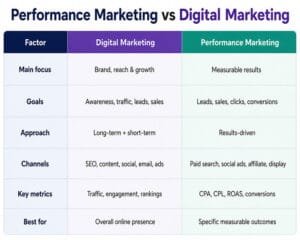
The biggest difference is what each approach is designed to prioritize.
1. Goals
Digital marketing can have many goals, including:
- Building brand awareness
- Increasing website traffic
- Generating leads
- Improving engagement
- Building customer relationships
- Increasing sales
Performance marketing usually starts with a clearly defined action such as a lead, purchase, signup, click, or booking.
Both can support business growth, but performance marketing is more closely tied to measurable conversion goals.
2. Measurement
Measurement is at the heart of performance marketing.
Businesses track performance marketing metrics such as:
- Cost Per Click (CPC)
- Cost Per Lead (CPL)
- Cost Per Acquisition (CPA)
- Conversion Rate
- Return on Ad Spend (ROAS)
- Click-Through Rate (CTR)
- Customer Acquisition Cost (CAC)
These numbers help marketers understand what’s working and where campaign budgets or strategies need to change.
Digital marketing can also be measured through traffic, rankings, engagement, leads, and conversions, but some activities, such as SEO and content marketing, often deliver value over a longer period.
3. Time Horizon
Digital marketing usually combines short-term campaigns with long-term brand building.
SEO may take time to build visibility, while content can gradually establish trust and authority.
Performance marketing focuses more directly on active campaign results. However, “performance” doesn’t mean instant results. Audience quality, creative, landing pages, competition, budget, and optimization all influence outcomes.
4. Payment and Budget Approach
One feature of performance based marketing is its strong connection to measurable actions.
Depending on the campaign, businesses may pay based on clicks, leads, sales, or other defined outcomes. Paid search and affiliate marketing are common examples.
However, performance marketing doesn’t always mean you pay only after a sale. The payment structure depends on the platform, campaign type, and agreement.
What Are the Main Performance Marketing Channels?
Businesses can use several performance marketing channels, depending on their audience and goals.
Paid Search: Helps businesses reach people actively searching for products or services through platforms such as Google Ads.
Social Media Advertising: Platforms such as Meta and LinkedIn allow businesses to reach specific audiences and optimize campaigns around defined objectives.
Display Advertising: Uses visual ads across websites and digital platforms to support targeted campaigns.
Affiliate Marketing: Businesses work with partners who promote their products or services and receive compensation for qualifying actions.
The right channel depends on your audience, industry, budget, and campaign goal.
How to Build a Performance Marketing Strategy
A strong performance marketing strategy starts with a clear objective.
First, decide whether you want leads, purchases, bookings, registrations, or another measurable action.
Next, define your audience and select channels that are relevant to them. Then make sure the entire customer journey supports the campaign. A strong advertisement won’t perform well if the landing page is confusing or the conversion process is difficult.
Finally, test different audiences, creatives, offers, landing pages, and campaign settings. Review the results regularly and optimize based on actual data.
Performance Marketing Metrics to Track
The right performance marketing metrics depend on your goal.
For lead generation, CPL and conversion rate may be important.
For ecommerce, CPA, ROAS, average order value, and revenue may matter more.
For some campaigns, reach and impressions can still provide useful context.
The important thing is to connect each metric to a real business objective rather than focusing only on surface-level numbers.
Which One Should Your Business Choose?
The answer usually isn’t performance marketing or digital marketing.
Most businesses can benefit from both.
Digital marketing provides the broader framework for building visibility, trust, traffic, and customer relationships. Performance marketing can support specific goals where measurable actions and campaign efficiency are important.
For example, a business might use SEO and content to build organic visibility, social media to strengthen its brand, and paid campaigns to generate targeted leads.
Together, these activities can work as one connected growth strategy.
Branduo Studio, Performance Marketing Agency in Pune
Performance marketing works best when campaigns are connected to actual business outcomes.
At Branduo Studio, we help businesses plan and manage performance campaigns with a focus on audience targeting, campaign strategy, creative testing, conversion tracking, and continuous optimization.
Rather than looking only at clicks and impressions, we focus on understanding how campaign performance connects to your business goals.
If you’re looking for a performance marketing agency in Pune, connect with Branduo Studio and build a data-driven strategy around your growth objectives.
FAQs
1. What is Performance Marketing in simple terms?
What is Performance Marketing? It is a results-focused marketing approach where campaigns are planned, tracked, and optimized around measurable actions such as clicks, leads, sales, or signups.
2. What is the difference between performance marketing and digital marketing?
Digital marketing covers a wide range of online marketing activities, while performance marketing focuses more specifically on measurable actions and campaign outcomes.
3. Is performance marketing the same as paid advertising?
Not exactly. Paid advertising is an important part of performance marketing, but the broader approach can also include affiliate marketing and other outcome-focused activities.
4. What are the most common performance marketing channels?
Common performance marketing channels include paid search, social media advertising, display advertising, and affiliate marketing.
5. Which performance marketing metrics should I track?
Useful performance marketing metrics include CPC, CPL, CPA, conversion rate, CTR, ROAS, and CAC. The right metrics depend on the campaign objective.
6. Can small businesses use performance marketing?
Yes. Performance campaigns can be adapted to different budgets and business sizes. Clear goals, proper tracking, and regular optimization are key to making them effective.
Final Thoughts
Understanding What is Performance Marketing becomes easier when you see it as part of the wider digital marketing ecosystem.
Digital marketing helps businesses build visibility, trust, and long-term relationships. Performance marketing puts greater emphasis on measurable actions, campaign data, and optimization.
The right approach depends on your business goals.
Instead of asking which one is better, ask which combination of strategies can help your business reach the right audience and achieve measurable growth.
When targeting, creative, tracking, and optimization work together, performance marketing can become a powerful part of your overall digital marketing strategy.